Pharmaceutical and medical device companies spend years building supply chains that meet GDP standards. Every link in that chain (manufacturer, wholesaler, warehouse, distributor) is audited, validated, and documented.
But for years, the final transport layer (the light commercial vehicles moving blood products between hospitals, pharmaceutical replenishments to clinical sites, medical devices to surgical centres) operated outside the regulatory framework that governed everything else in the chain. These are vans that up until July 1stare not following the same rules that apply to trucks. They have no tachograph requirements, no mandatory rest rules and no enforceable documentation of driver hours.
From 1 July 2026, that changes. And for healthcare logistics, the stakes of getting it wrong are in a different category entirely.
The Logistics Regulation Gap That Just Closed
Under the EU’s Mobility PackageI, vans and light commercial vehicles over 2.5 tonnes used in international transport are now subject to the same social rules that have governed heavy goods vehicles for decades. That means mandatory Smart Tachograph 2 installation, enforced driving time limits, documented rest periods, and posting-of-workers declarations for cross-border assignments.
Smart Tachograph 2 gives authorities real-time, data-driven visibility:
- Border crossings are logged automatically everythree hours.
- Remote DSRC scanning can flag a non-compliant vehicle before it reaches a checkpoint.
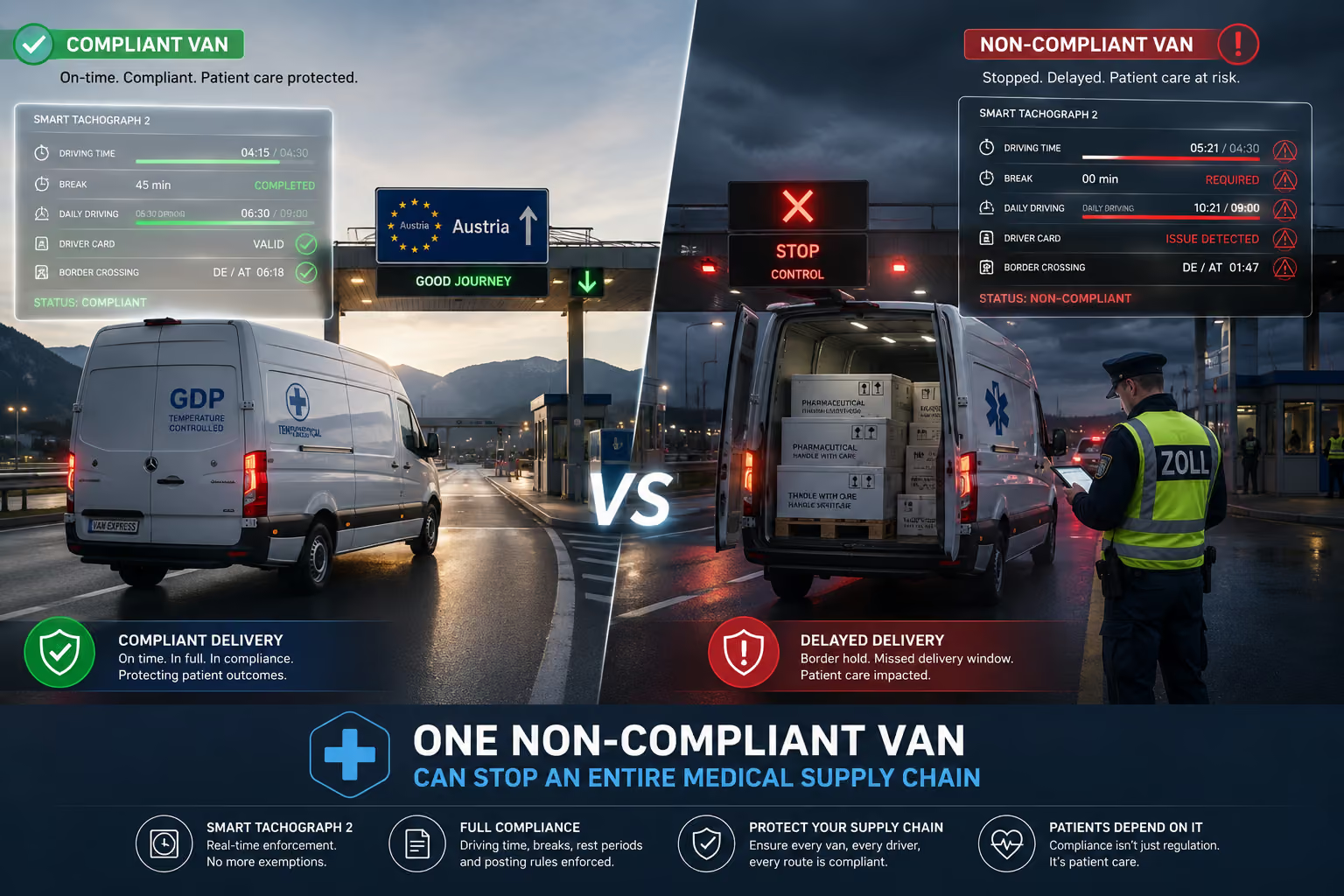
- A van crossing Germany into Austria overnight with no documented rest is now visible, traceable, and stoppable.
For most industries, a stopped van means a delayed delivery and a fine. For medical and pharmaceutical logistics, it can mean something far more serious.
When a Stopped Van Becomes a Patient-Care Problem
Consider a routine scenario: a van departs a logistics hub in Germany at 22:00, carrying temperature-sensitive pharmaceutical replenishment for a hospital in Vienna, with a hard deliverywindow of 06:00. Under the pre-2026 model, that route worked: it was fast, direct, and met the window consistently.
Under the rules that apply from July 2026, the same driver must take a mandatory 45-minute break after 4.5 hours of driving, with a daily driving time capped at 9 hours. A vehicle that is non-compliant on either count will be stopped at the border and held untilthe violation is resolved. As a consequence, the van does not arrive at 06:00 causing the hospital’s morning surgical schedule a supply gap it did not plan for.
As Koert Bloemers writes in The 2026 EU Logistics Transformation Playbook, one delayed medical delivery can cost more than a fine by risking patient outcomes. Pharmaceuticals and medical supply are classified as a High exposure sector under the 2026 regulatory framework, precisely because the tolerance for failure is zero.
Temperature-sensitive cargo compounds this further. A van held at a border point for several hours may be a temperature excursion. And a temperature excursion in a pharmaceutical shipment triggers GDP incident documentation, quarantine assessment, and in many cases, product destruction. The compliance failure in transport creates a compliance failure in the product chain.
GDP Compliance and Transport Compliance Are Now the Same Question
This is the connection that many pharmaceutical procurement teams have not yet made.
Good Distribution Practice guidelines already require that transport partners demonstrate documented quality systems, temperature validation, chain-of-custody integrity, and driver training. The assumption has always been that the physical movement of the goods was handled by a provider who met those standards.
What July 2026 adds is a new mandatory layer of that same documentation logic applied to driver behaviour,vehicle data, and route planning. A carrier who cannot provide clean tachograph records is a carrier who cannot provide clean GDP audit documentation. They are the same evidence base.
Health authorities and contracted hospitals are already beginning to include transport compliance requirements in SLA reviews. If your logistics partner cannot demonstrate tachograph data integrity, continuous driver card records, and compliant route planning, that gap will eventually appear in your own audit trail.
The Subcontractor Problem
Many medical logistics operations rely on subcontractors for a portion of their cross-border volume —covering peak demand, specialist routes, or regional gaps in their own fleet. This is where the 2026 regulations create a specific vulnerability that the sector has not fully reckoned with.
When EU social rules apply to a vehicle, they apply to the entire planning and dispatch structure. That includes subcontractors. A primary carrier who is fully compliant but dispatches 20% of their medical volume through a subcontractor who has not yet installed Smart Tachograph 2 is not, in practice, a fully compliant partner. Their subcontractor’s van is the one that gets stopped. Your cargo is on it.
The questions worth asking ofevery transport partner in your medical logistics network:
- Are all vehicles in scope — including subcontractors —fitted with Smart Tachograph 2?
- Can driver card continuity be demonstrated across the full 28-day inspection window?
- Has route planning been restructured to align mandatory rest stops with hospital access windows?
- Are posting-of-workers declarations filed in advance for all cross-border routes?
- Can the carrier provide compliance reporting as part of SLA documentation for health authority reviews?
If the answer to any of theseis uncertain, the risk sits with your supply chain until it is resolved.
What Compliant Medical Logistics Looks Like After July 2026
A transport partner that is genuinely prepared for medical and pharmaceutical logistics in the post-July environment has done more than install hardware. They have redesigned how routes are planned so that mandatory rest stops align with — rather than conflictwith — clinical delivery windows. They have built compliance reporting into their client communication so that audit documentation is available without having to request it. And they have taken the same zero-tolerance approach to driver card continuity and tachograph data integrity that their pharmaceutical clients apply to temperature records and chain-of-custody logs.
This kind of operational discipline is not new to logistics providers who have worked in regulated sectors. But it is a significant step for carriers who have operated vans as a faster, lighter alternative to HGV logistics without the accompanying documentation obligations.
The difference will be visible quickly after enforcement begins. The carriers who are prepared will move through border corridors without delay. The ones who are not will be stopped —and when they are stopped, it will be your temperature-sensitive cargo sittingon the roadside.
Van Express operates dedicated medical and pharmaceutical logistics across EU cross-border routes. If you want to understand how compliant transport integrates with your existing GDP documentation framework — and what to look for in a carrier before your next SLA review — book a call with our team.